About kidney cancer
Kidney or renal cancer is cancer that begins in the kidneys. Your kidneys are two bean-shaped organs, located on each side of your spine and behind your abdominal organs. Renal cancer is twice as common in men. The risk of kidney cancer increases with age, and most cases occur in people over 50.
Most kidney cancers are discovered without any symptoms, and at an early stage, when the cancer is small and confined to the kidney. This may be because imaging techniques such as CT and MRI scans are being used more often, leading to incidental discovery of kidney tumours.
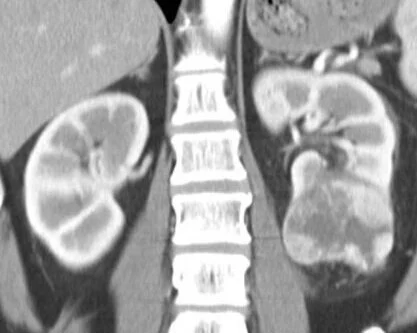
Kidney cancer shown on a coronal CT scan.
Symptoms
Kidney cancer usually doesn't have signs or symptoms in its early stages. With time, symptoms may develop, including:
Blood in your urine, which may appear pink, red or cola colored
Pain in your back or sides
Loss of appetite
Loss of weight
Lethargy
Fever
Tests
Imaging tests
Kidney cancers are usually diagnosed by imaging scans such as ultrasound, CT, or MRI.
Renal mass biopsy
A biopsy of the kidney mass may be performed under local anesthesia in some circumstances to confirm the diagnosis of kidney cancer.
Stages of Kidney Cancer
There are a number of stages in the development of kidney cancer. Early stage kidney cancer has excellent long-term cure rates with surgical treatment.
Stage I
The tumor is confined to the kidney and is 7 cm or smaller in size.
Stage II
The tumor is larger than 7 cm in size and is located only in the kidney.
Stage III
The tumor is any size and has spread to nearby lymph nodes, or the cancer has spread to the major veins or fatty tissue around the kidney.
Stage IV
The tumor has spread beyond the kidney to more the lymph nodes, adrenal gland or distant parts of the body such as the liver, lungs, bone or brain.
Treatment
Many treatment options exist for kidney cancer depending on the stage of the cancer. Surgery is the best treatment option for most patients with a localised kidney tumour. Treatment options include:
Active surveillance
Regularly monitoring the tumour for symptoms, growth or any other changes
Non-surgical ablative treatments
Radio-frequency ablation or cryo-ablation uses energy delivered via needles inserted into the tumour. These treatments are only suitable in selected patients and is performed by our interventional radiology colleagues.
Partial nephrectomy
A partial nephrectomy is the surgical removal of the tumor alone and preserving the rest of the kidney. The goal of this surgery is to preserve kidney function and lower the risk of developing chronic kidney disease in the future without affecting cancer control. The USC Institute of Urology has one of the largest experiences with partial nephrectomy. Our experience and research shows that partial nephrectomy is possible in larger and more complex tumours in experienced hands. Newer approaches that use a smaller surgical incision, or cut, are associated with fewer side effects and a faster recovery.
Radical nephrectomy
A complete or radical nephrectomy involves removing the entire kidney, and a surrounding layer of healthy tissue. Occasionally additional nearby tissues such as the lymph nodes, adrenal gland or other structures are removed during the surgery.
Robotic surgery
Procedures of the kidney are particularly well-suited to robotic surgery. Compared to open surgery, both robot-assisted surgery is associated with less pain, less blood loss, shorter hospital stay, a faster recovery time. Dr. Ashrafi was part of a team of urological surgeons at the University of Southern California with one of the largest experiences with robotic-assisted kidney surgery in the world.